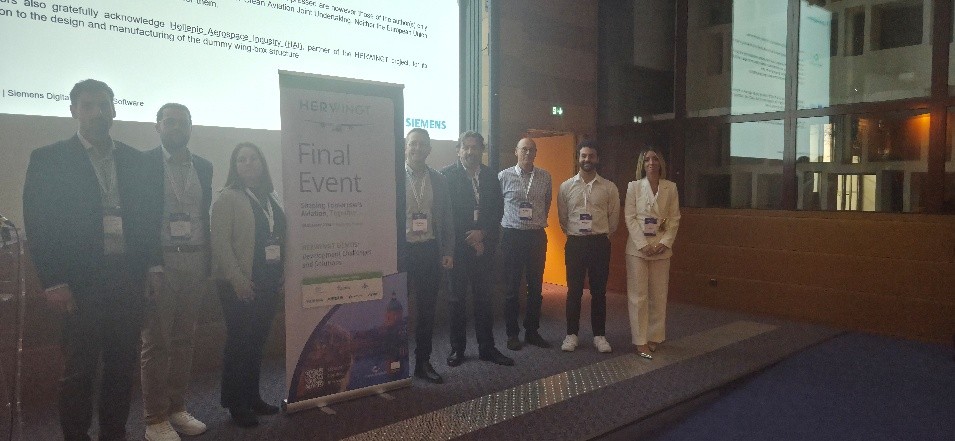
On October 29, 2026, at the 16th EASN International Conference, the HERWINGT session entitled “HERWINGT Demos: Development Challenges and Solutions” provided attendees with a unique opportunity to gain behind-the-scenes insight into the technological innovations developed within the HERWINGT project. The session showcased the challenges encountered, solutions implemented, and lessons learned during the development of cutting-edge demonstrators in Liquid Resin Infusion (HAI, Aciturri, Airbus Defence and Space), Thermoplastic Technologies (AIMEN), and Morphing Structures (CIRA, TU Delft, Siemens). Presented by the teams leading these developments, the session offered valuable perspectives on the practical realities of advanced aeronautical research, industrial implementation, and innovation, highlighting the pathways from concept development to demonstrator validation.
More specifically,
AIRBUS, represented by the demo leader Ana Maria Rodriguez Hench, showcased the HERWINGT Pylon-to-Pylon (P2P) demonstrator, a significant advancement in the application of Liquid Resin Infusion (LRI) technology to torsion box structures. Building on the achievements of the CSK2 demonstrator and leveraging materials currently under qualification, the P2P demonstrator aimed to extend the capabilities of LRI by enabling the infusion of thicker structures, enhancing component integration, and accommodating more complex geometries, including dihedral and sweepback configurations. The work focused on the development and optimisation of manufacturing processes, the enhancement of hot-forming and infusion tooling, and the full exploitation of material capabilities, particularly in terms of fibre steering and seamless component integration. This approach demonstrated the potential of advanced composite manufacturing technologies to support the next generation of efficient and innovative aerostructures.
TUDELFT, represented by the demo leader Ilias Tsatsas, explained the “Experimental testing of spanwise wingbox deformation effects on the achieved morphing trailing‑edge shapes of the Translation Induced Camber concept”. The concept of camber morphing has demonstrated significant aerodynamic benefits, with experimental studies reporting drag reductions of up to 50% under subsonic operating conditions. One notable implementation is the Translation Induced Camber (TRIC) concept, developed by TU Delft, which employs a discontinuous trailing-edge design and a tailored-thickness skin capable of sliding along the pressure side to achieve controlled camber variations. Previous wind-tunnel investigations validated the concept’s aerodynamic potential, demonstrating a delay in boundary-layer transition corresponding to approximately 15% of the wing chord across different morphing configurations.
While earlier wind-tunnel and bench-top evaluations assumed a rigid wingbox structure, modern high-aspect-ratio wings are characterized by considerable elastic deformation during operation. To address this gap, the presented experiment investigated the influence of spanwise wingbox deformation on the resulting morphing shapes. By providing the first experimental measurements of this previously unexplored phenomenon, the study offered valuable insights into the interaction between structural flexibility and morphing performance, potentially introducing a new design parameter for future adaptive wing systems and next-generation aircraft configurations.
You can also watch the related video here.
CIRA, represented by the demo leader Maria Chiara Noviello, walked us through the route “From Conceptual Design to Preliminary Functional Testing: Development and Experimental Maturation of a Morphing Trailing Edge Flap Demonstrator”. As the aviation industry advances towards cleaner and more sustainable air transport, morphing technologies are gaining prominence as powerful solutions for improving aerodynamic efficiency and aircraft performance. Developed within the Clean Aviation HERWINGT project, the compliant Morphing Trailing Edge Flap (MTEF) represents an innovative approach to enhancing the aerodynamic characteristics of a strut-braced wing configuration while supporting structural weight reduction for next-generation hybrid-electric regional aircraft.
The paper presents the full development pathway of the MTEF demonstrator, from its early conceptual design and optimization phases to manufacturing and initial functional assessment. The results demonstrate the successful maturation of a promising morphing technology into a robust hardware demonstrator ready to undergo experimental validation and support future sustainable aircraft concepts.
Key improvements: enhanced readability, stronger aviation-industry tone, smoother transitions, reduced repetition, and a more polished narrative suitable for a professional aerospace newsletter or conference publication.
Watch the video dedicated to the Morphing Trailing Edge Flap Demonstrator here
Hellenic Aerospace Industry (HAI), represented by the demo leader Evangelo Karachalio, showcased the Design, Analysis & Manufacturing of LRI Thermoset Leading-Edge Demonstrator.
Morphing and advanced composite technologies are playing a crucial role in shaping the next generation of sustainable aircraft. Significant efforts have been devoted to the design, analysis, and manufacturing of the baseline thermoset leading-edge structure.
A key challenge of this work was the implementation of a single-shot Liquid Resin Infusion (LRI) manufacturing process for an innovative hybrid sandwich-LRI configuration. Beyond manufacturing feasibility, the developed structure was required to meet stringent aerospace performance criteria, including resistance to aerodynamic pressure loads and compliance with bird-strike certification requirements, while maintaining an optimized weight profile. The study therefore demonstrates the successful integration of advanced manufacturing techniques and structural design methodologies to support the development of efficient and resilient aircraft structures for future aviation applications.
SONACA Espana, represented by the demo leader Antonio José Almenara Yébenes, presented the progress made by HERWINGT Project in developing a highly integrated flap demonstrator using advanced liquid resin infusion (LRI) technologies. The paper, authored by José Martín Bravo, María del Rocío Palomo Vera, Luis Miguel Sepúlveda Ramos, Pablo de Castro Cruz and Francisco Javier González González, explores innovative manufacturing solutions to develop more integrated and efficient aeronautical structures.
SIEMENS Industry Software,represented by Davide Mastrodicasa, delivered a presentation on “Experimental Geometry Reconstruction and Numerical Validation of a Full-Scale Morphing Aileron Demonstrator”. This work presents the experimental investigation of a full-scale morphing aileron demonstrator developed within the HERWINGT project. The study focuses on the reconstruction of the three-dimensional deformed geometry of the morphing structure and on the validation of the corresponding numerical models through laboratory and wind tunnel testing. Initial experimental activities included quasi-static and dynamic actuation tests aimed at characterizing the response of the demonstrator across a representative range of operating conditions. Shape measurements were performed using a multi-camera optical system combined with Digital Image Correlation (DIC), enabling non-contact reconstruction of the deformation field with high spatial resolution.
AIMEN, represented by the demo leader Massimiliano Russello, showcased “A Scalable Resistance Welding System for Thermoplastic Composite Leading Edges: From Laboratory Optimization to Full-Scale Demonstrator Assembly”. As the aviation industry pursues lighter, more efficient, and sustainable aircraft, increasing attention is being directed toward the adoption of high-performance thermoplastic composites (TPCs) as an alternative to conventional thermoset materials. Owing to their enhanced toughness, suitability for faster out-of-autoclave manufacturing processes, and ability to be joined through welding rather than conventional metallic fasteners, thermoplastic composites offer significant advantages for next-generation aircraft structures.
This study addresses the particularly challenging task of assembling a wing leading-edge structure, characterized by complex curvatures and highly constrained internal geometries. The work focuses on the development of an automated resistance-welding system capable of operating within these confined spaces, adapting to intricate structural contours, and precisely controlling heat and pressure parameters to achieve high-quality welded joints. The resulting solution represents an important step toward the industrialization of advanced thermoplastic aircraft structures and the realization of lighter, more efficient airframe designs.
Stay tuned for more details about HERWINGT’s session at the 16th EASN International Conference in the upcoming and final HERWINGT Newsletter, Issue 8!